Home
Publications
The Wildlife of Tanzania: A Visual Guide to One of Earth's Greatest Natural Wonders
February 28, 2026
Tanzania is widely considered the finest wildlife destination on Earth. With over 22 national parks, 32 game reserves, and a staggering diversity of ecosystems — from high alpine moorlands on Kilimanjaro to the coral reefs of Zanzibar — the country protects an estimated 20% of all large mammals remaining in Africa. This is a land where the ancient and the extraordinary are simply everyday life. And for decades, it has been the living canvas of Tanzania's Tingatinga artists, whose bold, vivid paintings capture this wildlife in a way that no photograph quite manages. Explore the animals of Tanzania below — and at the end, discover how you can bring them home through authentic Tanzanian art at TingaTinga Art.
Tanzania's Wildlife: By the Numbers
Before diving into individual species, it's worth pausing at the scale of what Tanzania protects. The country is home to approximately 310 to 400 mammal species — the fourth highest count in Africa. It supports over 1,000 bird species, placing it third on the continent for avian diversity. There are 100 species of snake, hundreds of reptile and amphibian species, and thousands of insect species including over 100 varieties of dung beetle in the Serengeti alone. A full one-third of Tanzania's land mass is designated as protected territory.
These aren't just numbers. They represent an ecosystem in which the full web of life — predator and prey, scavenger and seed-disperser, parasite and host — still functions largely as it has for millions of years. Tanzania is one of the last places on Earth where you can witness this at scale.
The Big Five: Africa's Most Iconic Wildlife
The "Big Five" — lion, leopard, elephant, buffalo, and rhino — originally referred to the five most dangerous animals to hunt on foot. Today the term is shorthand for Africa's most sought-after safari sightings, and Tanzania is one of the best places in the world to see all five.
African Lion (Panthera leo)
Tanzania holds an estimated 50% of Africa's remaining wild lion population — roughly 11,500 to 14,000 individuals. The Serengeti and Ngorongoro Crater are the most famous lion habitats, but lions are also found in Ruaha, Nyerere, and Tarangire National Parks.
Lions are the only truly social cats in the world, living in groups called prides that can number up to 60 individuals in the Serengeti's most fertile areas. Female lions do the majority of hunting, often cooperating in coordinated ambushes on wildebeest, zebra, and buffalo. Males, with their iconic manes, spend much of their time defending territory and their pride's cubs from rival males.
The lion is a fixture of Tingatinga painting from Tanzania. Artists have depicted lions for generations — the powerful stance, the thick mane, the amber eyes — in compositions that range from intimate to epic. Authentic Tanzanian lion paintings from TingaTinga Art capture this animal not as a trophy or a postcard cliché, but as a living, breathing presence in a landscape that belongs to it.
African Leopard (Panthera pardus)
The leopard is Tanzania's most elusive large cat, and spotting one is considered by many safari-goers to be the ultimate achievement. Nocturnal and secretive by nature, leopards are solitary hunters who haul prey much heavier than themselves into trees to keep it away from lions and hyenas.
Tanzania's leopard population — once estimated at around 39,000 — has contracted significantly as human settlements have expanded and prey populations have been reduced by poaching. Today they are considered vulnerable to extinction across much of their African range. The best places to see them in Tanzania are the Serengeti, Ruaha, and the Seronera Valley.
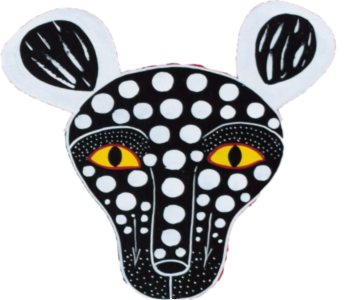
Leopards are among the most beautifully marked animals on Earth. Their rosette-patterned coats — which serve as camouflage in dappled forest light — have long captivated Tanzanian artists, who render the spotted coat in intricate detail using the Tingatinga technique of building up color in small, deliberate brushstrokes.
African Elephant (Loxodonta africana)
The African elephant is the largest land animal on Earth, and Tanzania is one of the best countries on the continent to see them. Tarangire National Park, in particular, hosts some of the highest elephant concentrations anywhere in Africa — during the dry season, herds numbering in the hundreds converge on the Tarangire River in scenes of remarkable drama.
Elephants are extraordinarily intelligent animals, with long memories, complex emotional lives, and intricate social structures built around a matriarch — typically the oldest and most experienced female in a herd. They communicate through low-frequency rumbles that can travel for kilometers through the ground, coordinate their movements across vast distances, and grieve their dead in ways that continue to astonish researchers.
Tanzania's elephant population has recovered significantly after severe poaching in the 1980s and a second crisis in the early 2010s, thanks to intensified anti-poaching efforts and international ivory trade bans. Current estimates place Tanzania's elephant population at roughly 60,000 individuals.
African Buffalo (Syncerus caffer)
The Cape buffalo is arguably the most dangerous animal in Tanzania, responsible for more human fatalities annually than lions or leopards. This reputation is earned: buffalo are massively built, possess curved horns capable of killing lions, and have a well-documented tendency to circle back and ambush hunters who have wounded them.
Despite their fearsome reputation, buffalo are grazers — and remarkably social ones. Herds of several hundred, sometimes over a thousand, buffalo move together across the Serengeti and other Tanzanian parks, their numbers offering protection against predators. Old bulls, expelled from the herd, are known as "dagga boys" (from a Zulu word for mud) and tend to be the most dangerous animals to approach on foot.
Black Rhino (Diceros bicornis)
The black rhinoceros is the rarest of the Big Five and one of the most critically endangered large mammals on Earth. Tanzania holds one of the continent's most important black rhino populations, with animals found primarily in the Ngorongoro Crater and the Serengeti. The Ngorongoro Crater is considered one of the best places in Africa to observe black rhinos in the wild, as the crater's enclosed geography means the animals cannot easily leave and are often seen in the open.
Black rhinos are smaller and more aggressive than their white rhino cousins, with hooked upper lips adapted for browsing on woody vegetation rather than grazing. They are poached almost exclusively for their horns, which are trafficked into Asian markets where they are falsely believed to have medicinal properties.
The Great Migration: Tanzania's Most Spectacular Event
No wildlife guide to Tanzania is complete without the Great Migration — arguably the most dramatic wildlife spectacle on Earth. Every year, approximately 1.5 million wildebeest, 200,000 zebra, and 300,000 Thomson's gazelle complete a circular 2,000-kilometer journey through the Serengeti ecosystem, following rainfall and fresh grass.
The migration is continuous — there is no single start or end point — but the most dramatic moments occur at the river crossings, where massive columns of wildebeest plunge into the Grumeti and Mara Rivers, braving currents and enormous Nile crocodiles waiting at the banks. It is both brutal and breathtaking: tens of thousands of animals may cross a single stretch of river in a single day, with crocodiles pulling individuals underwater as the rest surge past.
The Serengeti's calving season (January to March in the southern Serengeti) is equally remarkable — up to 8,000 wildebeest calves are born daily during the peak of calving, and cheetahs, lions, hyenas, and jackals converge on the birthing grounds.
Tanzania's Big Cats Beyond the Lion
Cheetah (Acinonyx jubatus)
The cheetah is the fastest land animal on Earth, capable of reaching speeds of around 112 kilometers per hour in short sprints. Unlike lions and leopards, cheetahs are diurnal hunters — they hunt during the day, relying on speed rather than stealth. This makes them among the most reliably viewable of Tanzania's big cats.
The Serengeti's open plains are ideal cheetah habitat, with the wide sightlines and abundance of Thomson's gazelle that cheetahs depend on. Ruaha National Park in southern Tanzania is also an excellent location. Cheetahs are increasingly threatened by habitat loss, human-wildlife conflict, and competition from larger predators.
In Tingatinga art, cheetahs are depicted with characteristic spotted coats and slender, aerodynamic bodies — their speed and elegance rendered in the bold, confident lines that define the Tanzanian painting tradition.
Serval (Leptailurus serval)
The serval is one of Tanzania's less-celebrated but genuinely beautiful cats — a medium-sized spotted feline with extraordinarily large ears that give it exceptional hearing for locating prey in tall grass. Servals are found across most of Tanzania's savannah habitats and are sometimes seen in the early morning or evening near water sources. They hunt primarily by leaping high into the air and pinning prey with their forepaws — a technique that is remarkably effective on small rodents and birds.
Primates: Chimpanzees, Colobus, and More
Tanzania's western forests are home to one of Africa's most important chimpanzee populations, centered in Gombe Stream National Park and the Mahale Mountains — both on the shores of Lake Tanganyika. Gombe is the site where Jane Goodall conducted her landmark research beginning in 1960, fundamentally changing our understanding of primate behavior and human evolution.
Chimpanzees share approximately 98.7% of their DNA with humans, and watching them is an experience that most visitors describe as profoundly affecting. Their social complexity, tool use, and emotional expressiveness make them unlike any other wildlife encounter.
Tanzania also supports several monkey species, including the red colobus monkey found only on Zanzibar's Unguja island — one of the rarest primates in Africa, found only in the Jozani Forest — and the black-and-white colobus, vervets, olive baboons, and blue monkeys found across the country's forests and parks.
Giraffes, Zebras, and the Grazers of the Serengeti
The giraffe is Tanzania's national animal. The Masai giraffe (Giraffa camelopardalis tippelskirchi) — with its distinctive star-shaped coat patterns — is the subspecies found throughout Tanzania, and it is a common sight in virtually every major national park. Despite their height (up to 6 meters), giraffes are vulnerable to lions when drinking, as they must splay their forelegs awkwardly to reach water, leaving them momentarily unable to flee.
Plains zebra (Equus quagga) are among the most numerous large mammals in Tanzania, forming the vast columns that accompany wildebeest in the Great Migration. Their black-and-white stripe patterns — unique to each individual, like a fingerprint — have long fascinated scientists and artists alike.
Other notable grazers include topi, kongoni (Coke's hartebeest), impala, eland (the largest of all antelopes), and Thomson's gazelle. The warthog — made famous internationally by The Lion King's character Pumbaa — is an endearing and surprisingly entertaining presence at most Tanzanian parks, often found trotting purposefully in single file, tails raised like radio antennas.
Hippopotamus and Nile Crocodile: Rulers of the Rivers
Hippopotamus (Hippopotamus amphibius)
Tanzania hosts one of the largest hippopotamus populations remaining in Africa, with an estimated 20,000 individuals across the country. Hippos are found in rivers and lakes in virtually every major park, but are particularly abundant in Nyerere (Selous), Katavi, and Ruaha National Parks.
Despite their somewhat comedic appearance, hippos are among Africa's most dangerous animals — fast, territorial, and unpredictable on land, particularly at night when they leave the water to graze. They secrete a natural pinkish fluid that functions simultaneously as sunscreen and antibacterial protection — one of nature's more elegant solutions.
Nile Crocodile (Crocodylus niloticus)
The Nile crocodile is the largest reptile in Africa and one of the most ancient predator lineages on Earth — crocodilians have existed largely unchanged for over 200 million years. In Tanzania, Nile crocodiles are found in most major rivers and lakes, reaching their most spectacular densities along the Rufiji River in Nyerere National Park.
Nile crocodiles are ambush predators of extraordinary patience — capable of lying motionless for hours before launching an explosive attack on animals coming to drink. During the Great Migration river crossings, crocodiles congregate in waiting at the Mara and Grumeti Rivers, where they account for a significant proportion of wildebeest mortality each year.
Tanzania's Birds: A Birdwatcher's Paradise
With over 1,000 recorded bird species — third highest in Africa — Tanzania is a world-class birding destination. A few highlights:
African Fish Eagle (Haliaeetus vocifer): The fish eagle's haunting, far-carrying call is one of the defining sounds of the African wilderness. Found near lakes and rivers throughout Tanzania, it hunts fish with spectacular aerial dives.
Lilac-breasted Roller (Coracias caudatus): One of Africa's most visually stunning birds, with a multicolored plumage of turquoise, lilac, green, and brown. It is a favorite subject of Tanzanian artists because of its extraordinary palette.
Ostrich (Struthio camelus): The world's largest bird, found across Tanzania's open plains. Males have striking black-and-white plumage and perform elaborate courtship dances.
Flamingo: Lake Natron in northern Tanzania is one of the world's most important lesser flamingo breeding sites, with populations numbering in the hundreds of thousands gathering on the soda lake's caustic shores.
Secretary Bird (Sagittarius serpentarius): One of Africa's most distinctive raptors, the secretary bird is a large, long-legged eagle that hunts on foot across open grasslands, stomping snakes and small mammals to death with powerful kicks.
Superb Starling (Lamprotornis superbus): A small, iridescent bird with metallic blue-green upperparts and a vivid orange-red breast, commonly seen throughout northern Tanzania. Its brilliant coloring makes it another popular subject for Tingatinga painters.
Southern Ground Hornbill (Bucorvus leadbeateri): A large, turkey-sized bird with striking red facial skin, the southern ground hornbill is one of Tanzania's most recognizable avian species and is considered a flagship species for conservation.
Reptiles: Chameleons, Cobras, and Sea Turtles
Tanzania's reptile diversity is significant and often underappreciated. The country's chameleons — including the remarkable flap-necked chameleon and numerous endemic species in the Eastern Arc Mountains — are among the most biologically fascinating animals in East Africa. Their independent eye movement, lightning-fast tongues, and color-changing ability (used primarily for communication rather than camouflage) have made them a perennial favorite in Tanzanian art and wildlife photography.
Five of the world's seven sea turtle species are found in Tanzania's coastal waters: the green turtle, hawksbill, loggerhead, leatherback, and olive ridley. All five are classified as endangered or critically endangered. Mafia Island and parts of the Zanzibar coast provide nesting beaches for green turtles, and conservation programs run by local communities and NGOs are working to protect nesting sites.
Tanzania's snake fauna includes 100 recorded species, among them the black mamba — one of the fastest and most venomous snakes in the world — the puff adder, spitting cobras, and the large and non-venomous African rock python. Rock pythons are constrictors capable of taking large prey including impalas and small crocodiles.
Marine Wildlife: Zanzibar and the Indian Ocean Coast
Tanzania's 800-kilometer Indian Ocean coastline and the islands of Zanzibar, Pemba, and Mafia form one of the richest marine ecosystems in the western Indian Ocean. The coral reefs here support an extraordinary diversity of marine life, and the warm waters attract larger pelagic animals seasonally.
Whale sharks (Rhincodon typus) — the largest fish on Earth — aggregate seasonally around Mafia Island and the waters south of Dar es Salaam. Dolphins are commonly seen year-round along the Zanzibar coast, where pods of bottlenose and spinner dolphins frequently approach boats. Humpback whales pass through Tanzanian waters during their annual migration, and manta rays patrol the outer reef walls.
The Zanzibar coastline is also famous for its sea turtles, and between January and May, visitors sometimes witness green turtle hatchlings emerging from nests on protected beaches — one of the most moving experiences Tanzania's coast has to offer.
Conservation in Tanzania: Protecting What Remains
Tanzania's extraordinary wildlife is not self-sustaining without active protection. Poaching — particularly of elephants for ivory and rhinos for horn — remains a persistent threat despite improved enforcement. Habitat loss from agricultural expansion and human population growth continues to fragment wildlife corridors. Climate change is already affecting water availability in critical ecosystems like the Serengeti.
Tanzania has responded with a combination of government enforcement, community-based conservation programs, and wildlife tourism that creates economic incentives for local communities to protect rather than exploit their wildlife. The country's network of national parks and game reserves represents one of the most ambitious conservation efforts anywhere in the world.
Supporting African culture and creative industries — including purchasing authentic Tanzanian artwork — is one concrete way to contribute to the economic vitality of communities that live alongside this wildlife.
Tanzania's Wildlife in Art: The Tingatinga Tradition
For over 50 years, Tanzania's Tingatinga artists have been painting the wildlife that surrounds them. The style originated in Dar es Salaam in the late 1960s with Edward Said Tingatinga, who developed a distinctive approach — bold black outlines, saturated enamel-bright colors, dynamic compositions — that proved remarkably suited to capturing the energy and beauty of East African animals.
Today, the Tingatinga tradition is carried forward by hundreds of artists in Tanzania, many of them trained in family workshops that pass down techniques across generations. Lions, elephants, giraffes, zebras, cheetahs, flamingos, chameleons, and fish all feature prominently in the work — rendered not as illustrations but as vivid, expressive interpretations of the world these artists live within.
At TingaTinga Art, you can buy authentic handmade Tingatinga paintings directly from Tanzanian artists. Every piece is an original — painted by hand in Dar es Salaam using high-quality oil and acrylic paints on canvas. Nothing is printed. Nothing is mass-produced. When you purchase a painting, you are getting a unique work of art and directly supporting the Tanzanian artist who created it.
TingaTinga Art ships worldwide with tracking and insurance. The website also allows you to make an offer, which makes genuine Tanzanian wildlife art accessible at a variety of price points. Whether you want a sweeping Serengeti landscape, a detailed elephant portrait, a colorful bird composition, or a dramatic lion painting, the artists at TingaTinga Art can deliver — and they can also accept commissions for custom subjects.
If Tanzania's wildlife has captured your imagination — through this article, through a safari, through a documentary, or through a lifelong fascination — there is no better way to bring it into your home than through a painting made by someone who has lived alongside these animals their entire life.
Final Thoughts
Tanzania is not simply a place with good wildlife. It is one of the last places on Earth where the full machinery of a functioning ecosystem — predators, prey, scavengers, decomposers, grazers, browsers, and the plants they depend on — still runs at something close to its original scale. To see it is to understand what much of the world's land surface once looked like, before humans reduced it.
Protecting and celebrating that world matters — in conservation policy, in tourism choices, in education, and in art. The Tingatinga painters of Tanzania have understood this for decades. Their work is not decoration. It is testimony.
Explore authentic Tanzanian wildlife paintings at TingaTingaArt.com — and bring a piece of Tanzania home.
Every painting at TingaTingaArt.com is handmade by a Tanzanian artist in Dar es Salaam. Worldwide shipping. Custom commissions welcome.