September 26, 2026
There is a particular moment on safari that people tend to remember long after the photographs have been forgotten.
The vehicle has stopped. The engine is quiet. The guide points somewhere into the pale grass and, for a few seconds, you see nothing. Then a shape moves. A head rises. A pair of amber eyes appears between the stems.
A real lion. Not the movie poster version. Not the cartoon. Just a life unfolding.
Once you look beyond the mane and the roar, lions become infinitely more complicated—and infinitely more interesting.
The Real Lion (Not the King of the Jungle)
Lions are not kings, and they do not live in jungles. They are animals of savannahs and grasslands where prey is abundant enough to sustain them. Tanzania's Serengeti is one of the world's greatest lion landscapes precisely because its populations of wildebeest, zebra, and gazelles provide the food base on which predators depend. UNESCO records roughly 4,000 lions within the Serengeti National Park.
A lion's world is not a throne room. It is a constantly changing ecological system where water, prey, territory, and other lions determine whether an individual survives. Unlike most large cats, lions do not experience this world alone. That is what makes them unusual.
A Cub's First Months: Hidden and Vulnerable
A lion's life begins much more quietly than people imagine. A lioness gives birth away from the pride, in a concealed location. Litters are usually between one and four cubs. For several weeks, their world is essentially a hiding place.
This is one of the most dangerous periods of a lion's life. Cubs face hunger, disease, predators, and the threat of adult males. When a new male coalition takes control of a pride, they may kill cubs sired by previous males. It is brutal, but it is connected to lion reproductive strategy: eliminating dependent cubs allows incoming males to father their own offspring sooner.
The Smithsonian estimates that up to 80 percent of cubs die within their first two years. So every surviving cub has already made it through one of the hardest parts of being a lion.
The Pride Is a Family Network
Eventually, cubs integrate into the pride. Lionesses often raise their young in association with other related females—sisters, mothers, aunts. Female lions usually form the long-term social core of a pride, remaining together for years and sometimes generations. Female cubs often stay in their birth pride as adults, while young males eventually leave.
A pride is not simply a collection of lions that happened to meet. It is, in many ways, a family network with a structure that can persist for generations.
The Lioness Carries the Work
Popular culture has spent decades making the male lion the star. Nature has a different arrangement.
Lionesses are generally the primary hunters of the pride. They are deeply involved in raising cubs, maintaining the group's social structure, and defending territory. The division of labour in many prides means lionesses carry a remarkable amount of the routine work required to keep the group alive.
Hunting is not simply a matter of running faster than prey. Lions are ambush predators. They need to get close before making their explosive attack. Cooperation can make the difference between eating and going hungry. Some hunts involve several animals approaching from different directions, with one lion driving prey toward others positioned nearby.
The Hunt Often Fails
This is perhaps the most important thing a first-time safari visitor can understand: lions fail. A lot.
Wild prey are alert, fast, defensive, and dangerous. A buffalo does not wait to become dinner. Zebra can kick. Wildebeest can outrun a poorly positioned lion. A pride may stalk prey for a long distance and then abandon the attempt. Sometimes the target sees them. Sometimes the wind changes. Sometimes the attack succeeds—but defending the kill brings new dangers.
Why Lions Fight Over Food
Cooperation can quickly turn into competition around a carcass. The lion that helped make the kill does not necessarily get a peaceful dinner. Large prey can attract multiple lions, hyenas, and other scavengers. Within the pride itself, adults may push ahead while smaller cubs wait.
Cubs tend to be at the bottom of the feeding hierarchy. This produces a strange contradiction at the heart of lion society: lions need each other, but lions are also competing with each other. Family life does not eliminate hierarchy. It exists alongside it.
The Young Male's Dangerous Journey
A young male does not simply grow a mane and become "king." He is generally pushed out of his birth pride when he reaches adolescence, around two to four years of age. Then life gets dangerous.
Young males may travel alone or, more commonly, form a coalition with brothers, cousins, or unrelated males. These coalitions are one of the most fascinating features of lion behaviour. A young male who would have little chance of taking over a pride alone may have a realistic chance when working with another male.
They travel together. Rest together. Hunt together. Defend one another. And eventually, if they survive long enough, they may challenge the males controlling an established pride.
The romantic image is of one magnificent male walking across the savannah. The biological reality is often more about partnerships.
The Mane Is More Than Decoration
The mane is associated with sexual maturity and social competition. Its size and colour provide information about the male—age, condition, and competitive ability. It is almost like a biological advertisement communicating information to other lions.
To a safari visitor, the mane is one of the most unforgettable sights in Africa. To a Tanzanian painter, it provides an extraordinary artistic opportunity. The mane is a mass of movement, texture, and colour—precisely why lions translate so naturally into the bold outlines and intense colour fields of Tingatinga art.
What Lions Actually Do All Day
Lions sleep and rest for long periods. Hunting is energetically expensive, particularly when the hunt ends unsuccessfully. When there is no immediate reason to move, conserving energy makes sense.
A lion may spend hours lying in shade. Then it may stand, walk a short distance, lie down again. Perhaps groom another pride member. Perhaps roar. Then sleep.
For a tourist expecting continuous drama, this can seem disappointing. But stay with the lions. The stillness is part of the spectacle. A lion lying motionless beneath an acacia tree is conserving energy in an environment where food is unpredictable and temperatures can become intense.
The Roar: Long-Distance Communication
People often imagine the lion's roar as an aggressive sound used mainly to frighten prey. That is not what it is for.
The roar is primarily communication. Lions roar to advertise their presence, maintain contact with pride members, and communicate across territory. A roar can be heard for more than 8 kilometres in suitable conditions, which is particularly important because a pride may fragment into smaller groups during the day—some resting, others hunting, others elsewhere within the territory.
The roar becomes a kind of long-distance social signal. Imagine standing on the Serengeti after dark and hearing one lion call from somewhere beyond your line of sight. Then another answers. Then another. Suddenly the landscape feels much larger. The animals you cannot see are still there.
Territory, Neighbours, and Intelligence
A pride's territory is not simply empty land they wander through. It contains food, water, resting places, and access to prey. But the most important resource may be the security that comes from controlling good territory.
A group of lions does not need to see another pride to know it is there. Sound provides information. How many lions are roaring? How many males? How close are they? Are they moving toward the territory? For the lions, this is not background noise. It is intelligence.
The Most Dangerous Period of a Male's Life
There is a fascinating irony: the animal that appears most impressive to us—the large adult male with the enormous mane—may be relatively secure compared with the young male who has not yet established himself.
Young males live a nomadic existence. They may be forced to move constantly. They may go long periods without food. They risk injury in fights. They cross roads and human-dominated landscapes. They may approach unfamiliar prides and be driven away. And they can die without ever becoming resident males.
So the magnificent male lion sitting proudly on a kopje is not born king. He may have spent years earning the right to be there.
Territory Is More Than a Map
It is tempting to imagine a pride's territory as a neat shape drawn on a wildlife map. The reality is messier. The value of territory depends on the conditions within it: a river, permanent water, productive grassland, prey concentration, shelter, access to females, distance from rival groups.
Research from the Serengeti shows that larger and more successful prides can be associated with better-quality territories, while groups living in poorer areas may be forced into marginal habitat. This is why the lion should never be separated from the landscape. You cannot tell the story of a Serengeti lion without talking about grass, rain, wildebeest, zebra, water, and space.
Why Tanzania Matters for Lions
The Serengeti is one of the world's great large-mammal ecosystems, supporting one of the planet's most remarkable predator-prey systems sustained by enormous populations of migrating herbivores.
The Ngorongoro Conservation Area combines an enclosed volcanic landscape with abundant wildlife, creating an extraordinary environment for large predators. It has one of the highest densities of mammalian predators in Africa.
Ruaha, further south, is a major wilderness area known for large lion and elephant populations.
Lake Manyara is famous for an unusual behaviour: tree-climbing lions.
There is no single "Tanzanian lion experience." The lions of the Serengeti, Ngorongoro, Manyara, and southern Tanzanian wildernesses live within different landscapes and ecological conditions. The scenery changes. The prey changes. The vegetation changes. And the lions adapt.
What It Feels Like to See a Lion in Tanzania
A photograph cannot completely prepare you for the experience. One reason is scale. A lion looks large on a screen. It looks different when the animal is standing beside your safari vehicle and you suddenly appreciate the size of its head, the thickness of its neck, and the power in its shoulders.
Another reason is silence. People often expect a safari to be noisy. It isn't always. Sometimes you will sit with a pride for twenty minutes and hear almost nothing. The lion is lying in the grass. The birds continue. Wind moves through the vegetation. A zebra grazes in the distance. Then the lion lifts its head.
That is when you realize you are not simply looking at an animal. You are watching a life unfolding.
Lions and Other Predators
A lion does not occupy the African ecosystem alone. It competes with spotted hyenas, leopards, wild dogs, and other predators. This competition is sometimes dramatic. Lions can kill competing carnivores. Hyenas can challenge lions around carcasses. Both species can steal food from one another.
The result is not a simple hierarchy where one animal "wins" every encounter. Instead, there is a constantly shifting balance of risk and opportunity. The real spectacle is not merely seeing a lion. It is seeing the network around the lion: a hyena calling in the distance, vultures beginning to circle, wildebeest moving nervously, a leopard disappearing into grass. Everything is connected.
When Lions Meet People
Lions need large landscapes and abundant wild prey. But people live throughout much of the African landscape. Where livestock, farms, and wild predators overlap, conflict occurs. A lion that kills livestock can threaten a family's livelihood. People may respond by killing the lion.
Habitat loss, fragmentation, prey depletion, and human-lion conflict are among the major threats facing the species. Modern lion conservation cannot be reduced to simply creating parks and keeping people away. The future of lions is tied to whether communities living alongside wildlife can coexist with them.
Because there is a human dimension to every conservation statistic. A surviving pride represents ecological success. But it also depends on the people who share the landscape with it.
The Uncomfortable Truth
Lions remain one of the most visible animals in Africa, which can make it easy to assume they are thriving everywhere. They are not.
Panthera estimates that roughly 24,000 wild lions remain in Africa, compared with vastly larger numbers historically. This is one reason Tanzania's protected landscapes matter so much. When a visitor photographs a lion in Tanzania, they are photographing more than an iconic animal. They are seeing a survivor of an increasingly fragmented world.
Why Artists Keep Returning to the Lion
There is something almost inevitable about the lion becoming a subject in Tanzanian painting. Photographers pursue the lion because of movement, expression, light, and behaviour. Artists can do something different. They can exaggerate, simplify, recolour, enlarge, flatten, and turn a natural animal into a symbol.
This is particularly evident in the Tingatinga tradition that developed in Tanzania in the 1960s. Edward Saidi Tingatinga's early works used bold colours, strong outlines, and stylized depictions of wildlife, laying the foundation for a distinctive East African artistic tradition.
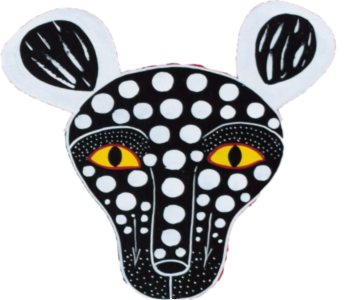
Tingatinga art does not need to make the lion anatomically realistic to make it recognizable. A pair of eyes. A circular mane. A powerful silhouette. A few intense colours. Suddenly the animal is there. Not necessarily the lion you saw through your binoculars—but the lion you remember. That distinction matters.
A Lion Painting Is Not a Safari Photograph
A photograph records what was there. A painting can record what the experience meant.
Imagine a safari visitor returning home from Tanzania after seeing a male lion at sunset. The photograph might show the exact animal. But a painting could use deep orange, red, turquoise, purple, and black to convey something the camera did not: the heat of the landscape, the intensity of the encounter, and the almost surreal quality of seeing a wild lion in an enormous African landscape.
That is where Tingatinga-style wildlife painting becomes particularly powerful. The style is famous for vivid colour, graphic outlines, and imaginative compositions. And because the paintings are made by hand rather than reproduced mechanically, each artist interprets the subject slightly differently.
When the Lion Becomes Art: Examples
Gaze by Kalmal does something a photograph cannot. The lion looks directly toward the viewer, but its colouring moves away from naturalism entirely. The mane becomes a field of colour, turning the animal into something almost dreamlike. The result still reads immediately as a lion, but it is no longer trying to be a wildlife photograph. It is an interpretation of power.
Many lion paintings show the animal drinking, resting, or moving through landscapes that combine several visual ideas associated with Tanzania—wildlife, landscape, water, mountains, and the tension between different animals sharing the same environment. The subject is no longer simply "a lion" but a moment within a larger ecological story.
Some of the most compelling wildlife compositions are about family and intimate moments rather than dominance. A lion with cubs surrounded by birds, foliage, and strong blocks of colour reminds us that the actual lion story is not mainly about one magnificent male standing alone. It is about mothers, sisters, cubs, brothers, coalitions, rival males, neighbours, and the relationships connecting all of them.
For those interested in seeing the Big Five together, Kings of the Serengeti brings the lion together with elephant, buffalo, leopard, and rhinoceros in a single composition—a stunning reminder of Africa's wildlife diversity.
Why Lion Paintings Work as African Wall Art
Lions have visual presence. A lion's face naturally attracts attention. The mane gives an artist a large circular field for colour and texture. The animal's body creates a strong horizontal or vertical composition. And the symbolism is immediately understandable even to someone who has never visited Africa.
A quieter lion painting can work in a bedroom or study. A large, intensely coloured lion can dominate a living-room wall. A pair of lion paintings can create symmetry. A pride scene can provide a more narrative piece. For people furnishing homes inspired by African interiors, the lion can become a focal point rather than simply another decorative image.
What Makes a Handmade Tanzanian Lion Painting Different
There are plenty of "African lion prints" available online. A digital print can reproduce an image thousands of times. A handmade painting is fundamentally different. There is a surface. There are brushstrokes. There are small irregularities. There is evidence that a person actually worked through the composition.
At TingaTinga African Art, the paintings are made in Tanzania and the collection includes works by numerous Tanzanian artists. The artwork is handmade rather than prints and we work directly with artists in Tanzania.
For someone who has actually travelled to East Africa, that provenance can add another layer to the artwork. The painting doesn't merely depict Africa. It was made in Africa. That distinction is especially meaningful when the subject is wildlife. Learn more about why you should choose handmade Tanzanian art.
What If You Have Your Own Lion Photograph?
You do not necessarily have to choose between buying a painting of someone else's lion and hanging your safari photographs. You can combine the two ideas.
TingaTinga African Art offers a Photo Into Painting service, allowing customers to have photographs transformed into painted artwork. Imagine taking a photograph during your Tanzania safari—perhaps a lion beside a kopje, a lioness with cubs, or a pride crossing the road—and then having that memory interpreted as a physical painting.
Suddenly, the artwork is not merely "a lion painting." It is your lion. Your journey. Your memory of Tanzania. That can make a particularly meaningful piece of African wall art.
The Lion in Your Painting May Not Be the Lion You Saw
And that is perfectly fine. In fact, it may be the entire point. Wildlife art does not need to compete with photography.
Photography answers: What did the lion look like?
Art can answer: What did the lion feel like?
A real lion may disappear into beige grass. A painter might surround it with electric blue. A real lion may be half-hidden behind a bush. The artist might place its entire body against a brilliant sunset. A real lion may look exhausted after a hunt. The painting might make it look enormous and monumental.
None of these things make the painting inaccurate in the artistic sense. They simply mean the artist is telling a different kind of truth.
The Lion as Symbol
Across many societies, lions have become symbols of courage, strength, leadership, and authority. But the actual animal gives us a more nuanced lesson.
Lions are powerful, but they are also vulnerable. They are fearsome predators, yet cubs can be extremely fragile. Males can appear invincible, yet young males face years of uncertainty. The pride depends on cooperation, but members also compete. A lion can dominate a landscape and still disappear when prey disappears.
That complexity is part of what makes the animal such a compelling artistic subject. The lion is not simply "strength." It is strength under pressure. Family under pressure. Survival under pressure.
A Lion's Complete Life Cycle
It begins with dependence. A cub spends its earliest months concealed and protected by its mother.
Then comes exploration. The cub learns to walk, play, stalk, and eventually participate in feeding.
A young female may remain with her family and eventually contribute to raising the next generation. A young male normally leaves. His childhood is over. He enters the wandering stage. He may form a coalition. He may spend years moving through unfamiliar territory.
Eventually, he may challenge resident males and gain access to a pride. For a time, he may become the dominant male. He mates. He helps defend territory. He may father cubs. And eventually another coalition comes. The cycle begins again.
This is why a pride can look stable from the outside while undergoing constant internal change. The lion standing in front of you today may not be there next year. His daughters may remain. Her sisters may remain. The young male may be replaced. The cubs may grow. The territory may change.
The landscape remains. The society changes.
The Final Chapter
Wild lions live difficult lives. Injuries accumulate. Teeth wear. Hunting becomes harder. Competition becomes more dangerous. An aging male can lose his ability to defend his position. An aging lioness can struggle to keep pace with younger hunters.
Eventually, every lion loses the thing it once had in abundance: physical resilience. This is one reason a photograph or painting can become strangely powerful after a safari. You may be looking at a single moment in a life that is constantly changing.
The lion appears permanent. It is not.
Why Seeing a Lion in Tanzania Changes Everything
Before visiting Africa, many people know lions primarily through books, documentaries, films, and photographs. After a safari, the animal tends to become something more specific.
You remember the exact patch of grass. The quality of the light. The dust. The sound of the engine stopping. The guide whispering. The distance between the vehicle and the animal.
And there is an important lesson: the lion is not performing for tourists. It has a life to live. It is deciding where to rest, where to hunt, where to drink, whether to approach another lion, whether a rival is too dangerous, whether the herd ahead is worth pursuing.
Your presence is only one small detail in an existence that began long before you arrived. That is what makes the encounter special.
Bringing Africa Home
For many people, a safari ends at the airport. The memories, however, continue.
A photograph sits on a phone. A few souvenirs end up in a suitcase. And eventually there is a question: How do I bring something of Africa home without simply turning the experience into decoration?
A Tanzanian painting can be one answer. Not because a painting can reproduce the Serengeti. It cannot. But because art can preserve a particular feeling about the place.
A brightly coloured lion hanging in a living room in London, Dubai, Singapore, Tokyo, New York, or Toronto may seem very far from the Serengeti. Yet the connection is simple. The painting was made in Tanzania. The subject comes from the wildlife that has become inseparable from Tanzania's identity. And the person looking at it remembers—or imagines—Africa.
That is one of the reasons handmade African art continues to travel far beyond the continent.
Explore the Lion Through Tanzanian Art
At TingaTinga African Art, the lion is only one part of a much broader collection of handmade African artwork. The collection extends well beyond lions to include elephants, giraffes, zebras, hippos, landscapes, cultural scenes, abstract works, and other forms of African art.
We offer standard artwork sizes ranging from approximately 50 cm pieces to much larger works around 140 × 110 cm, with custom sizing also available.
Explore the Tingatinga collection, where bold colour, stylized wildlife, and imaginative compositions continue the artistic tradition that began in Tanzania in the 1960s. Or browse the Contemporary collection, the Cultural collection, Landscape paintings, and Abstract works to see the full range of handmade African art available.
The Last Thing You Should Remember
The lion is easy to admire. It is much harder to understand.
It is tempting to reduce the animal to a mane, a roar, and the word "king." But the real lion is more interesting. It is a daughter that never leaves her family. A mother carrying the burden of raising cubs in an unforgiving environment. A brother travelling beside another brother. A young male crossing kilometres of unfamiliar country in search of a future. A coalition testing the strength of another coalition.
A pride scattering across a territory and reuniting later. A lioness calculating whether the herd ahead is worth the energy. An old male losing a battle he once would have won. A cub surviving when most others will not.
A roar travelling across the darkness of the Serengeti. And somewhere, perhaps not far away, another lion answering.
That is the life of the lion. Not a fairytale. Not a cartoon. Not really a king.
Something much more remarkable: a highly social predator trying to survive, generation after generation, in one of the most extraordinary ecosystems on Earth.
And perhaps that is why the lion continues to appear so often in Tanzanian art. Because when a safari is over and the dust has settled, people do not necessarily want to remember Africa exactly as a photograph recorded it. Sometimes they want to remember how it felt.
And that is what a great lion painting can do.
It can take the roar, the heat, the colours, the landscape, and the sense of being very small in a very large wilderness—and put them on a wall.
Made in Tanzania. Inspired by Africa. And carried home.